
Food Cart
Food Carts: An Old Trend
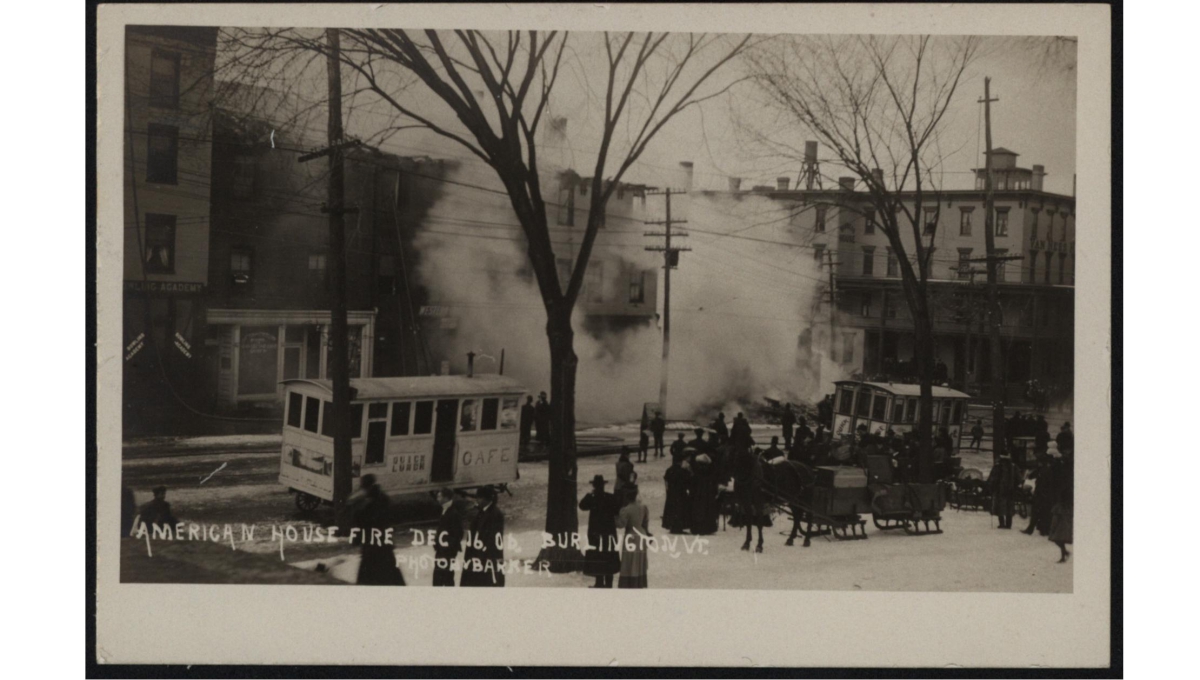
If you were standing at Church and College Streets in Burlington in 1892, you would have found a night lunch cart serving late-night customers. Food trucks may feel like a modern innovation, but Burlington’s mobile food scene stretches back at least 130 years. These carts served late-shift workers and anyone looking for a bite to eat after most of the city had gone dark. The carts were sometimes called “owls,” a nickname that reflected their late-night clientele––people out late for work or carousing. Night lunch carts were basic, open pushcarts or ones you could walk into. Separate licenses existed for lunch night carts, push carts, restaurants, and even popcorn stands. Vermont wasn’t alone in this trend. By 1896, Boston had hundreds of lunch carts, so many that the then mayor vetoed a lunch cart wagon request stating that city streets were meant for “locomotion” and not stationary structures (The Burlington Independent, February 15, 1896).
Late Night Food in a City with Few Restaurants
At the time, Burlington had many meat and fish markets, bakeries, and green grocers, but only a handful of restaurants. The Burlington City Directory from 1890 lists 76 retail grocers, 30 meat markets, 4 fish and oyster dealers, and 5 bakeries––but only 5 dining rooms and restaurants. For late-night workers especially, the lunch carts filled an important gap.
The Burlington Free Press reported that a Rutland lunch cart had arrived in Burlington the previous night and that “its owner proposes to stay here, providing the people take kindly to his sort of lunches” (December 1, 1892). The article did not describe the food, but other reports offer clues. The granddaughter of lunch cart owner Samuel Bergman later recalled that her father told stories of helping his father in the cart and preparing hamburgers and possibly frankfurters. Other glimpses of what might have been served come from newspaper accounts of arrests and robberies in or around lunch carts.
In one case a lunch cart owned by S. Kabler on lower College Street was robbed after closing. The thief stole nearly all the cart’s portable contents—including pies and eggs (maybe pickled), prompting Kabler to declare that “the cupboard was bare” (Burlington Weekly Free Press, September 16, 1909). In 1920, police arrested a man from a cart on the corner of Main Street and South Winooski Avenue after he had eaten “a sandwich and a glass of milk in the cart” (Burlington Weekly Free Press, January 8, 1920). Other foods served in Burlington and greater Vermont were clam chowder and steamed clams, baked beans, ice cream (on Saturday nights and Sundays), and even strawberry shortcake. Featured drinks were Moxie, birch beer, ginger ale, tea, and coffee.
Owners, Licenses, and Locations
City licensing records and newspaper reports reveal the names of other Burlington lunch cart operators or license applicants, all immigrants. Between the 1890s and early 1900s, these included at least a dozen men and one woman. Most of the carts appear to have been in downtown Burlington, especially around City Hall Park, Church Street, Main Street, and College Street.
Their locations mattered. Newspaper reporters treated them as visible parts of downtown life and took special notice when a new lunch cart opened in 1903 near Interval Avenue and North Street––an area now known as the Old North End.
Many of the carts had names. One newspaper mentioned a “Palace” lunch cart, which was reportedly moved by order of the police in 1893 (Burlington Independent, May 27, 1893). Samuel Bergman’s cart was known as “Uncle Sam (Burlington Daily News, June 2, 1906), and H.D. Stone’s night lunch, the “White House Café,” located at Church and Bank in 1895, and then moved the following year to the Y.M.C.A. building, then on the corner of Church and College (Burlington City Directory, 1895-96). The city required licenses to operate a night lunch cart, and the Board of Aldermen reviewed and voted on applications. In 1895, they granted a license to D. Neiburg but tabled a license request by H.D. and J.E. Thomas, after one alderman argued that it was “unfair to the people who pay rent to grant licenses for such a large structure as the proposed cart to occupy space on city property (Burlington Free Press, January 8, 1895). We do not know how much space!
But we do know the weight of at least one of the food carts. In 1895, a lunch cart proprietor, Arthur T. White, started a guessing contest on the weight of his cart. First prize was $15, second was $10, and third was $5. The Burlington Independent reported that between 3,000 – 4,000 people entered the contest (April 6, 1895, p 5). Would you have guessed 3,660 pounds?
Late Night Drama
The lunch carts also appear in newspaper reports about late-night altercations. An article in the Burlington Clipper described a “fracas” at a cart run by Mr. Sugarman (October 22, 1898). During the disturbance, he reportedly left the cart to avoid being beaten, and officials issued warrants for the arrest of the intruders. The article noted that this was the second disturbance reported at that location. Some nearby residents complained that the cart had become a gathering place for what they described as “objectionable characters,” whose loud conversations and profanity were heard from the street. One person complained that the loud talk could easily be heard outside the cart and “was not the sort of thing that women and children passing by would find edifying.” This suggests that their late-night presence sometimes made them controversial.
Sam Bergman’s “Uncle Sam”
Sam Bergman’s Uncle Sam seems to have generated the most public attention. His cart appears repeatedly in reports involving legal disputes, licensing battles, and neighborhood objections. In 1900, Bergman’s cart burned and he paid Peter L. Gay to build a new one. In 1902, Gay went to court to recover additional costs incurred when Bergman requested changes during construction of the replacement cart. He wins the cart, but not money for his labor and material. A number more court cases ensue about the same issue. It’s no wonder that the June 2, 1906 headline in the Burlington Daily News virtually yelled out “Famous Lunch Cart Case Over.” After six years of multiple cases, Peter Gay was granted only one cent for damages and costs––but Bergmann had to turn over his lunch cart to Gay.
By 1906, one newspaper remarked that the cart had probably had “more legal processes served upon it than any other vehicle of its kind in existence” (Burlington Weekly Free Press, June 7, 1906). It had, the paper noted, been through a bankruptcy, a chattel mortgage, a sheriff’s sale, a mechanic’s lien, and various court proceedings. The city revoked his license at least once, and in one incident an intruder “brandished a bread knife” picked up from inside the lunch cart and stabbed Bergman demanding five dollars (Burlington Daily News, February 24, 1908).
Yet Bergman stayed in business. By 1916, the city granted him a license to move his lunch cart to a location at Bank Street near Church Street. In 1917, people raised objections to his continued operation in yet another location. Bergman appeared before the Board pleading that he had been in business for 20-plus years and would be ruined if denied a license. A petition signed by many citizens supported him. In the end, the aldermen extended his license for another year (Burlington Weekly Free Press, July 5, 1917). Bergman’s story illustrates that lunch carts were more than businesses. They became gathering places and fixtures on the street––controversial to some but valued enough by customers and supporters that people were willing to speak up on their behalf.
Sometimes food cart owners later opened restaurants or turned their carts into diners at permanent locations. Bergman’s granddaughter reported that he opened a bricks and mortar dairy restaurant. Perhaps it was in the building that Bergman owned at 6-8 North Winooski Avenue. Look up as you pass by the building, now housing Radio Bean to see the Bergman name now set in stone. Recent Burlington examples include Skinny Pancake, Hong’s Chinese Dumplings, and Poco which all began as food carts or trucks. Lunch wagons were the forerunners of diners, such as Henry’s and the former Oasis. American diners influenced the establishment of similar eateries around the world.
With the current popularity of food trucks, Burlington’s night lunch carts remind us that what appears to be a modern trend is often rooted in much older tradition.